Travel to Greece
Day 6 Nafpaktos - Olympia - Sparta - Monemvasia (378 Km.)
Nafpaktos (Lepanto): On this day we have many kilometers to go, so before breakfast we make a short visit to Nafpaktos. In 1407 Naupacto became dominated by the Venetians, who changed the name to Lepanto. Undoubtedly, what stands out is its fortified port, where we find a monument commemorating the Battle of Lepanto (1571) and a statue of Miguel de Cervantes, who fought in that battle in which he lost his arm. We climb the alleys until we reach the old clock tower, from where we have fabulous views of the port and the Gulf of Corinth. At the top of the hill is the Venetian fortress, but we didn&aqcute;t go up to see it.
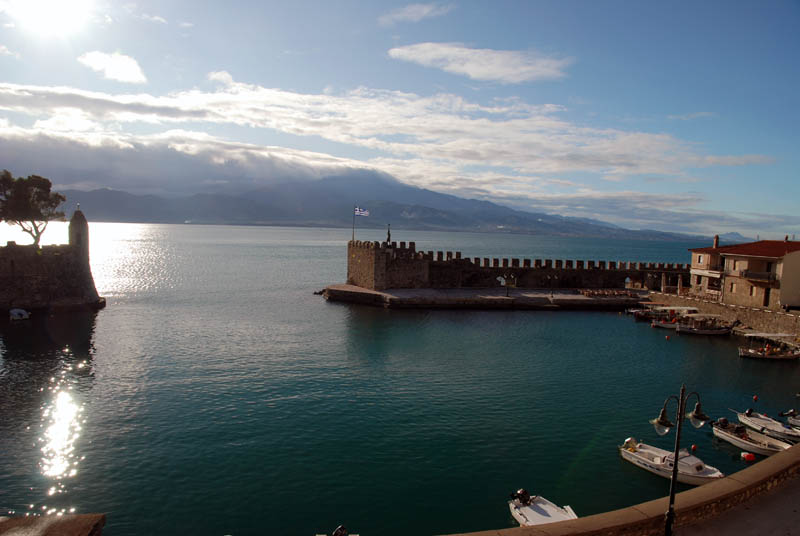
Port of Nafpaktos
On the way to the Rio–Antirrio Bridge we will visit Alberto's in-laws. We must thank the success of our trip thanks to Alberto's advices. Alberto's in-laws take us to see the church of San Jorge, located on top of a hill, from which we have beautiful views. It is a beautiful Orthodox church in which we can see in one of his paintings the image of St. George killing the dragon. After leaving Nafpaktia we crossed the Rio-Antirrio Bridge, inaugurated in 2004. The Rio-Antirrio Bridge, with a length of 2252 meters and a width of 28 meters, connects the northern part of the Peloponnese peninsula with the rest of Greece.
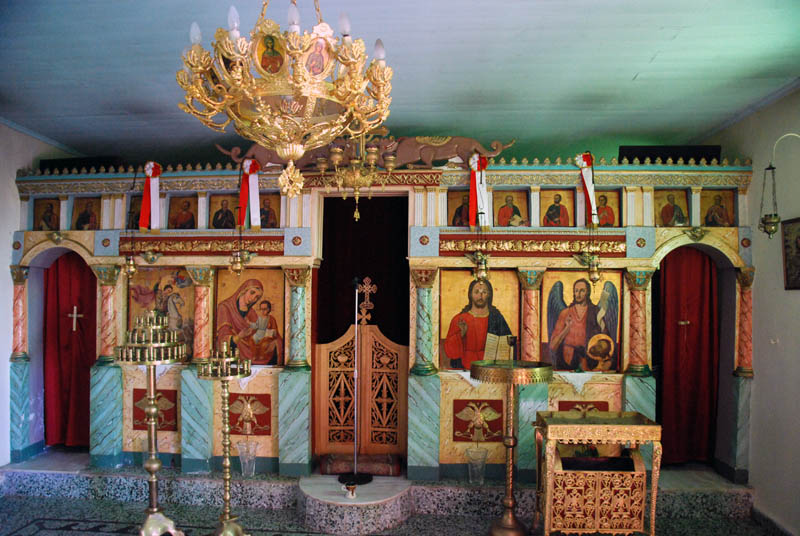
Nafpaktia - Church of St.George
(in 141 Km.) Ancient Olympia: Ancient Olympia is an archeological site located in the western part of the Peloponnese peninsula. In ancient times it was the seat of an important sanctuary and also the place where the Olympic Games were held every four years and were of comparable importance to the Pythian Games held in Delphi. The first of which is recorded were held in 776 a. C. In 1989, the archaeological site of Olympia was declared a World Heritage Site by Unesco. At the 2004 Olympic Games, held in Athens, the weight throwing tests were held at the Olympia´s stadium.
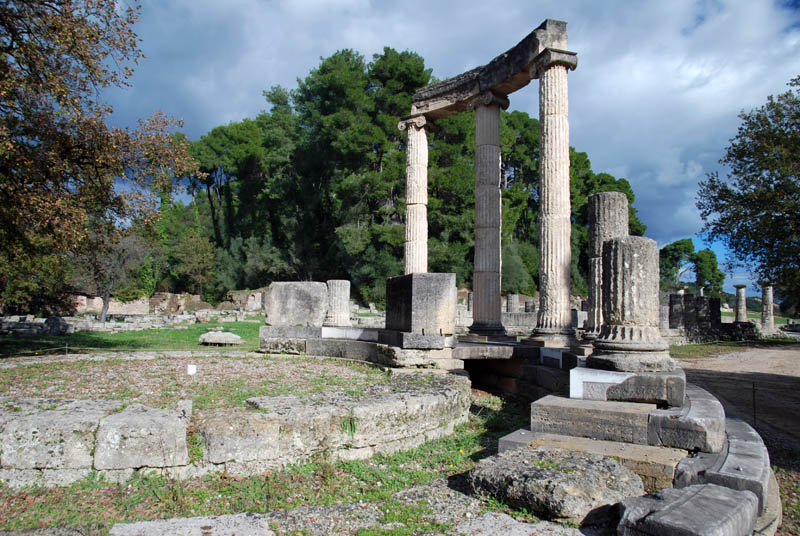
Olympia - Philippeion
The Temple of Hera was built in 600 BC., during the archaic period, over two previous temples, and is the oldest known large Greek temple (50 × 19.60 m). Between the Temple of Hera and the stadium the Greek polis built chapels (in Greek treasures). From the classical period we see the Temple of Zeus, from the year 460 BC. Currently we can see a column of the temple restored standing. Its architect was Libon of Elis. It has beautiful pediments and metopes. The Statue of Zeus, the work of Phidias, disappeared but it is known how it was from the coins and descriptions of chroniclers of the time. Nike of Paionios (421 BC) is one of the most beautiful classic statues. The pedestal is still inside the Altis, in the place of its primitive location, while the statue is preserved, incomplete, in the Archaeological Museum of Olympia.
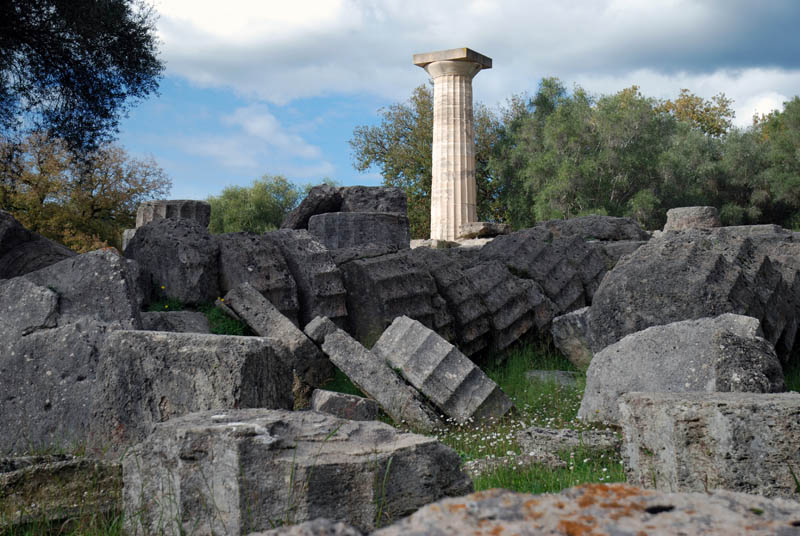
Olympia - Temple of Zeus
The Philippeion was an Ionic circular memorial in limestone and marble with columns around it. It was built by Philip II after the battle of Chaeronea (338 BC). It housed the statues that Leochares sculpted from Philip, Alexander the Great, Amintas, Olympia and Eurydice. They were gold and ivory. There are several statues of emperors dating from the Roman era. Around the Altis you can find a gym, the Palaestra built at the end of the 3rd century BC. that stands out for the number of Doric columns that surround it, the Leonidaion, a building built between 330 and 320 BC. for distinguished visitors, the Prytaneion and the Bouleuterion. The Hippodrome has disappeared completely, but part of the stadium remains.

Archaeological Museum of Olympia
Perhaps the ruins of Olympia are not the most spectacular of our trip to Greece, but in the other way its archaeological museum we liked it. The collections are distributed in twelve rooms, one of them dedicated to the Hermes of Praxiteles, a Greek marble sculpture with a height of 213 centimeters from 350-330 BC. The central hall is dedicated to the exhibition of some of the greatest works of Greek art, the pediments - 42 statues in total severe style - and metopes of the Temple of Zeus of Olympia. Another room is dedicated to the exhibition of the statue of the Nike of the calcific sculptor Paeonius, of marble, dated between the years 425 BC. and 421 BC. Another interesting parts of the museum are the collection of antique bronzes and the Workshop of Phidias.
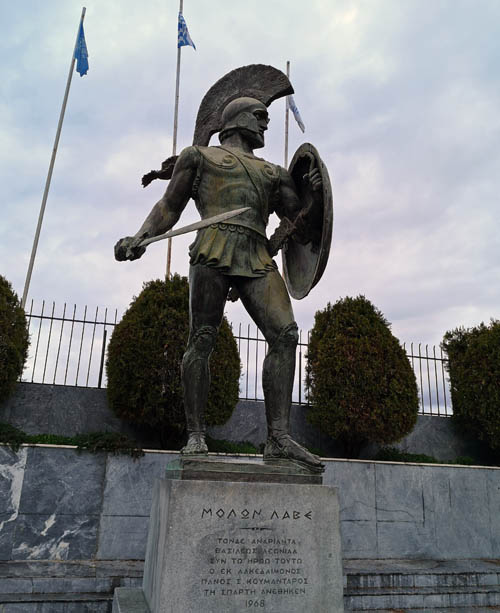
Sparta - Estatue of Leonidas
(in 150 Km.) Sparta: On our way towards Monemvasia we wanted to take a break in Sparta, to see the statue of Leonidas located at the end of Konstantinou Palaiologou Avenue and the acropolis of ancient Sparta. We had read in travel forums that the latter was a hill of free access, but when we arrived we found it fenced and it was necessary to pay to enter. At the time we arrived it was closed and we could not visit this site where the Temple of Athena and the Theater stand out.
(in 87 Km.) Monemvasia: We arrive at this fortified medieval town where we will sleep. After leaving the car outside the walls (access is not allowed by car), we walk the cobbled main street with our luggage until we reach our accommodation.